I Asked an AI Chatbot Where My Salary Ranks in India — Here's What Happened
TL;DR: Open Tax AI (bottom-right on any page), type your income in plain English, and it tells you your exact percentile among 8.22 crore ITR filers. No form, no sign-up. The screenshots below are from a real conversation.
Everyone Googles it. "Top 1% income India." "Is 15 lakh a good salary." "Where does my income rank." You land on a blog with a table, scan for your bracket, and leave. The number sits in your head for a day, then you forget it.
What if you could just ask?
Tax AI on ITR Stats now answers income percentile questions in a conversation. I typed in my income. Three seconds later, I had my exact rank among India's 8.22 crore taxpayers - computed live from official FY 2025-26 CBDT data. Here's exactly what happened.
The Conversation: Start to Answer in 3 Seconds
I opened Tax AI from the bottom-right corner of ITR Stats and typed a simple question:
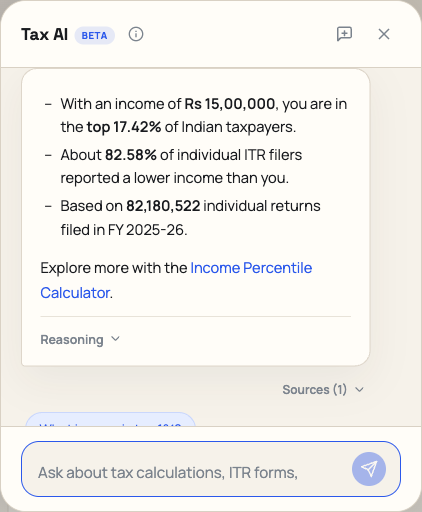
Real screenshot: Tax AI computing percentile for Rs 15 lakh income
No dropdown menus. No "select your assessment year." I typed "I earn 15 lakh per year. Where do I stand among Indian taxpayers?" and Tax AI came back with:
- Top 17.42% of Indian taxpayers
- 82.58% of individual ITR filers reported a lower income
- Based on 82,180,522 individual returns filed in FY 2025-26
- Source cited: Income Percentile Calculator on ITR Stats
Then it suggested follow-up questions. I clicked "What income is top 1%?" - a reverse lookup:
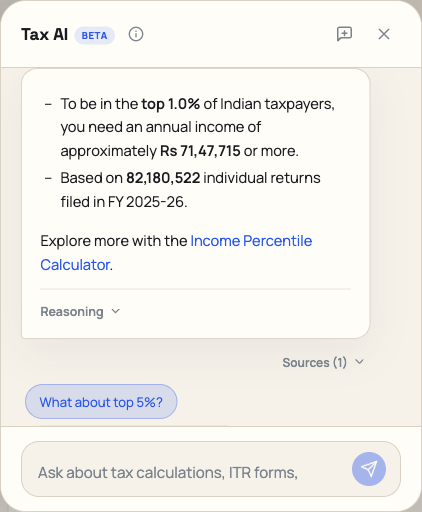
Real screenshot: Tax AI answering "What income is top 1%?" - a reverse percentile lookup
Answer: Rs 71,47,715 per year. Computed from the same dataset, same algorithm, same conversation. No page reload, no new form.
How Tax AI Computes This (It's Not a Guess)
This isn't ChatGPT pulling from general training data. Tax AI runs a real computation on every query:
You type your income
In any format - "15 lakh", "15,00,000", "1500000". Tax AI parses all of them.
It hits the percentile algorithm
The same code that powers the Income Percentile Calculator. Linear interpolation across 7 brackets from the e-Filing portal.
You get a cited answer
Every response includes the exact data source, filer count, and a link to verify the number yourself.
The underlying data: 8.22 crore individual ITR filings for FY 2025-26, published by CBDT on the Income Tax e-Filing portal. The algorithm uses linear interpolation within each income bracket to estimate your precise position. (For the full bracket-level breakdown, see India's Income Distribution.)
What Makes This Different From a Calculator
ITR Stats already has an Income Percentile Calculator. So why build the same thing into a chatbot?
Because conversations go somewhere that calculators can't.
A calculator gives you one number and stops. Tax AI lets you follow the thought wherever it goes - from "where do I stand?" to "how much tax do I owe?" to "which ITR form should I file?" All in the same chat window.
Tax AI is better when:
- You want a quick answer in plain English
- You have follow-up questions
- You're on mobile and don't want to fill a form
- You want percentile as part of a broader tax conversation
The Calculator is better when:
- You want a visual bar chart of the distribution
- You want to compare multiple income levels side-by-side
- You want the full bracket table on screen
- You want to share your result as an image
5 Questions to Try Right Now
Open Tax AI (the blue button at the bottom-right of this page) and try any of these:
- "I earn 12 lakh per year. What percentile am I in?" - the classic salaried question
- "What income is top 1% in India?" - the reverse lookup everyone Googles
- "Is 25 lakh a good salary? Where does it rank?" - context for a job offer
- "How much do I need to earn to be in the top 10%?" - goal-setting with real data
- "I earn 8 lakh. How much tax and what percentile?" - combine two questions in one
What Else Tax AI Can Do
Income percentile is just one of Tax AI's capabilities. In the same chat, you can ask about:
- Tax calculation - "Tax on 18 lakh under new regime?" (computes slab-by-slab)
- ITR form selection - "Salaried with mutual fund gains - which ITR?" (recommends ITR-2 with reasoning)
- Old vs new regime - "Old or new regime with 2 lakh in 80C?" (compares both)
- Tax notices - "How to respond to a 139(9) defective notice?" (step-by-step with deadline)
- Refund status - "Is refund processing slower than usual?" (checks live ITR Stats data)
- All 17 calculators - HRA, advance tax, TDS, SIP, PPF, EMI, and more
Every answer cites its source. Every computation links to the calculator you can verify against. No hallucinated tax rates, no outdated slab numbers.
Dive Deeper Into the Data
Want the full percentile tables, bracket breakdowns, and salary-specific analysis? These articles have the complete data:
Frequently Asked Questions
Yes. Tax AI on ITR Stats is completely free with no sign-up required. Click the Tax AI button on any page, type your question, and get an answer. There is no usage limit.
Tax AI runs the same algorithm as the ITR Stats Income Percentile Calculator. It uses bracket-level ITR filing data from the Income Tax e-Filing portal for FY 2025-26, covering 8.22 crore individual returns across 7 income brackets. Within each bracket, it uses linear interpolation to estimate your exact position.
Yes. After showing your percentile, Tax AI suggests follow-ups like "How much tax on this income?" or "Which ITR form should I file?" You can continue the conversation without starting over. It can also do reverse lookups - ask "What income is top 5%?" in the same chat.
Tax AI is purpose-built for Indian income tax. It computes answers from real CBDT data (not general training data), cites sources for every response, and connects to live ITR filing statistics. ChatGPT may give approximate or outdated answers. Tax AI gives exact numbers from official FY 2025-26 data and links to the source.
Tax AI handles ITR form selection, old vs new regime comparison, HRA and income tax calculations, advance tax, all 17 ITR Stats calculators, portal how-to steps, tax notice responses, filing statistics, and refund delay trends. It cannot file returns, check your PAN, or give personalized financial advice.